
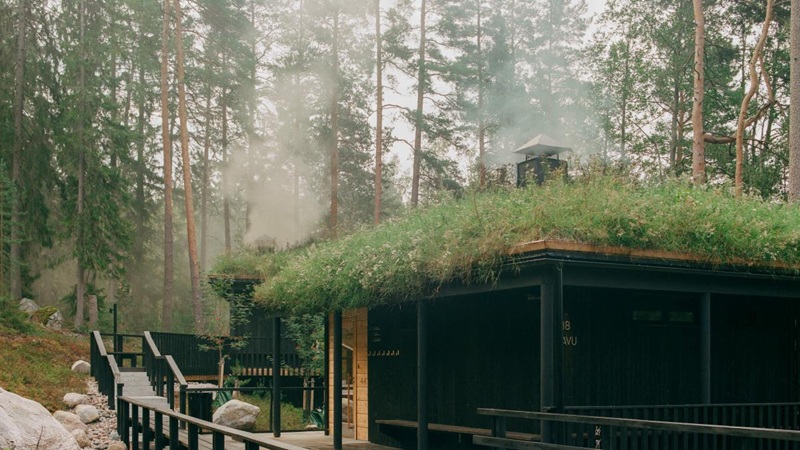
Kuusijärvi Smoke Saunas in Vantaa have won the 2026 Finlandia Prize for Architecture, Finland’s most prestigious architecture award. The new public smoke sauna complex demonstrates how a centuries-old Finnish sauna tradition can become an outstanding example of contemporary architecture. Dark timber, green roofs, the surrounding forest, the lake and a carefully designed route from the changing rooms to the smoke saunas and then to the water turn Kuusijärvi into a complete experience in which architecture becomes part of the sauna ritual itself.
On 5 October, the Finnish Association of Architects SAFA announced the winner of the 2026 Finlandia Prize for Architecture. The new Kuusijärvi Smoke Saunas in Vantaa were selected from four finalists.
The award is also a historic achievement for the city itself – this is the first time a building in Vantaa has received the Finlandia Prize for Architecture.
The victory is particularly noteworthy because Finland’s leading architecture award went not to a monumental cultural building, museum or prestigious private villa, but to a public smoke sauna complex.
Kuusijärvi Smoke Saunas combine tradition with contemporary architecture
The new smoke saunas were completed in summer 2025. The complex includes two new smoke saunas, a building containing changing and washing facilities, and a visitor information building.
The project was commissioned and developed by the City of Vantaa, while the architectural concept was created jointly by Mer Architects and Talli Architects.
At first glance, the buildings are clearly contemporary, yet their architecture has been deliberately designed to preserve the essence of the traditional Finnish smoke sauna.
Dark timber façades, low building volumes and green roofs help the new structures blend into the surrounding forest landscape rather than dominate it.
This relationship between architecture, sauna tradition and nature became one of the project’s defining qualities.
The sauna experience begins before entering the sauna
One of the most interesting features of Kuusijärvi is that the architects did not design only the sauna rooms themselves.
The visitor’s entire journey has been considered.
After changing, visitors step outside into the fresh air and surrounding forest. From there, a path leads to the smoke sauna. After heating up, they can return outdoors and continue towards the lake.
Moving between the separate buildings therefore becomes part of the sauna experience rather than an inconvenient necessity.
Researcher and author Timo Miettinen, who selected this year’s Finlandia Prize winner, particularly highlighted this sense of ritual created through architecture.
The buildings do not isolate visitors from nature. Instead, they repeatedly bring them back into contact with it.
Forest, cool air, smoke and dark timber
At Kuusijärvi, architecture influences the visitor through more than the form of the buildings.
Sensory experience is equally important.
After leaving the warm changing facilities, visitors encounter the cool outdoor air and surrounding forest. They then enter the darker atmosphere of the smoke sauna, with the smell of smoke, heated timber and hot stones.
Low lighting reinforces the sense of calm and separation from the outside world.
After the sauna, visitors return outdoors to the cool air, forest and lake.
This is very different from many modern spa complexes where almost every function is placed under a single roof.
At Kuusijärvi, nature is not simply attractive scenery beyond a window.
It is part of the sauna process itself.
Kuusijärvi Smoke Saunas are open to the public
It is particularly significant that the award was not given to a private luxury sauna or exclusive resort.
Kuusijärvi is a public recreational destination.
Explaining his decision, Timo Miettinen emphasised that beauty, sustainability and quality should be accessible to everyone.
He described the complex as an example of high-quality public architecture combining technical craftsmanship, aesthetics, accessibility, respect for nature and the ability to create a place where people can come together.
This is especially interesting in the context of sauna architecture.
Visitors do not simply observe high-quality architecture. They experience it physically – changing clothes, walking through the forest, sitting on the sauna bench, feeling the heat and smoke and then heading towards the lake.
Architecture becomes part of the physical experience.
One of the new smoke saunas is fully accessible
Accessibility is also incorporated directly into the buildings.
One of the new smoke saunas, Havu, was designed as an accessible sauna and accommodates 17 visitors.
The second new smoke sauna, Pihka, accommodates 27 people.
Altogether, the Kuusijärvi complex has four smoke saunas and four electrically heated saunas.
This illustrates an interesting direction for the development of traditional sauna culture.
The old technology of the smoke sauna is not being preserved as something untouchable to which modern visitors must simply adapt.
Instead, contemporary architecture adapts the space so that the traditional sauna experience can be enjoyed by a wider range of people.
Kuusijärvi Smoke Saunas continue a living tradition
Finnish sauna architecture in this project does not attempt to reproduce the past literally.
Following the award, Mer Architects’ Julia Hertell emphasised that Finland’s sauna architecture and design tradition remains alive and continues to reinvent itself.
Kuusijärvi demonstrates this principle particularly well.
The new buildings are not replicas of historic rural smoke saunas. They use contemporary architectural language, modern standards for public buildings and current principles of accessibility.
At the same time, the essential elements of the tradition remain – fire, smoke, timber, stones, darkness, forest, water and the transition between heat and cool air.
The tradition is therefore not preserved by simply reproducing the past.
It continues to live and evolve.
A smoke sauna can still be contemporary
The smoke sauna is one of the oldest forms of sauna culture in Northern Europe.
From a technological perspective, it may seem almost the opposite of the modern sauna with electronic controls, sensors, automation and remote operation.
Kuusijärvi demonstrates that tradition and modernity do not necessarily conflict.
Modernity does not have to mean only new heating technology.
Architecture, accessibility, visitor circulation, material choices, energy efficiency and the relationship between a building and its surrounding landscape can all be contemporary.
A traditional smoke sauna can therefore become a highly relevant piece of 21st-century architecture without losing its essential character.
Kuusijärvi holds a special place on Finland’s sauna map
Kuusijärvi is more than an architectural project.
The City of Vantaa describes it as the only place in the world where smoke saunas are heated every day throughout the year.
The complex stands beside Lake Kuusijärvi and forms part of a larger recreational area.
Visitors can also continue from the area towards Sipoonkorpi National Park.
Sauna therefore connects naturally with swimming, the forest and spending time outdoors.
This helps explain why it was so important for the architects not to separate the new buildings from their surroundings.
The forest and lake effectively become extensions of the sauna itself.
Kuusijärvi Smoke Saunas defeated strong architectural competition
The Finnish Association of Architects SAFA has awarded the Finlandia Prize for Architecture since 2014. The 2026 award was the 13th edition of the prize.
Its purpose is to highlight high-quality architecture and its importance to culture, society and human wellbeing.
Alongside Kuusijärvi, this year’s finalists included the Muurarimestari residential building in Helsinki, SKiB Campus Pori and the Lost Shtetl Museum of Jewish History in Lithuania.
Against such competition, the victory of a public sauna complex is particularly striking.
One of Finland’s most important architectural projects of the year is not a skyscraper, concert hall or enormous museum.
It is a public smoke sauna.
Sauna architecture can be genuine public architecture
Kuusijärvi also demonstrates that a sauna does not have to be viewed merely as a small auxiliary building in the garden of a private home or a single room within a spa complex.
It can be fully developed public architecture.
Such a project must address the same issues as any other public building – accessibility, visitor circulation, safety, sustainability, durability of materials and interaction with the surrounding environment.
But sauna architecture has an additional task.
It must create the right experience.
Architects need to consider how people move from heat to cold, where they rest, how they reach the water, what they see, which materials surround them and how naturally all these elements form a single process.
At Kuusijärvi, the combination of functionality and sensory experience has become one of the project’s greatest strengths.
Contemporary architecture helps an old tradition evolve
Preserving tradition is sometimes interpreted as a requirement to do everything exactly as it was done a century ago.
Kuusijärvi offers another approach.
The essence of the smoke sauna is preserved, but the buildings are designed for contemporary people and modern society.
They are publicly accessible, accommodate different visitor needs, use contemporary architectural language and remain closely connected with the forest, lake and traditional sauna culture.
Old and new do not exclude one another.
On the contrary, contemporary architecture helps an ancient tradition remain relevant.
Kuusijärvi Smoke Saunas show the future of an old tradition
The Finlandia Prize matters not only to the architects or the City of Vantaa.
It demonstrates that traditional sauna culture can remain relevant within a contemporary public environment.
An old tradition does not need to become a museum exhibit in order to survive.
Its essential principles can be preserved while modern requirements for accessibility, architecture, public use and interaction with nature are addressed.
That is precisely what has happened at Kuusijärvi.
Kuusijärvi Smoke Saunas winning the Finlandia Prize demonstrates that a sauna can be far more than a functional building containing a heater and benches. Here, architecture leads visitors from the coolness of the forest into the darkness of a smoke sauna, from heat to the waters of the lake and from individual relaxation to shared experience. Finland’s ancient smoke sauna tradition has not been turned into a museum exhibit. It has become one of the country’s finest examples of contemporary architecture.
Sources
Finnish Association of Architects SAFA – Reimagining Finnish Sauna Tradition: Kuusijärvi Smoke Saunas Win Finlandia Prize for Architecture.
City of Vantaa – Vantaan Kuusijärven uudet savusaunat voittivat Arkkitehtuurin Finlandia -palkinnon.
City of Vantaa – Kuusijärven saunat.


