
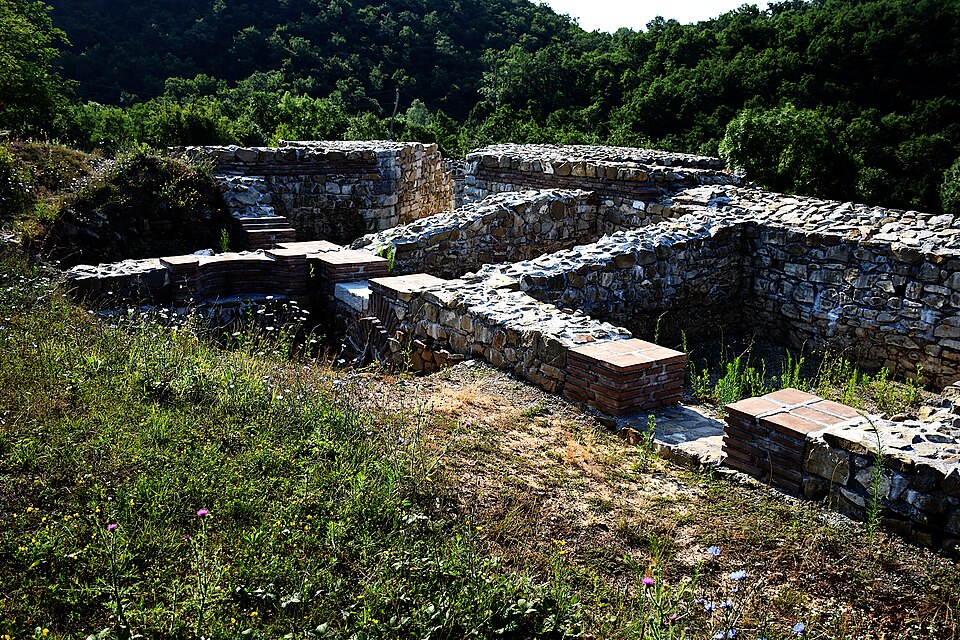
A Roman bath in Serbia has revealed something extraordinary to archaeologists: a luxurious private bathing complex was built into the lowest level of a massive defensive tower within an imperial palace. Three bathing pools, an underfloor heating system, a furnace and a special heated sweating room have been identified. The approximately 1,700-year-old discovery offers a fascinating glimpse into how heat, water and bathing formed part of everyday life among the elite of the Roman Empire.
The discovery was made at the Vrelo-Šarkamen archaeological complex in eastern Serbia, near Negotin. The site contains a fortified imperial residence dating from the early 4th century and associated with the Roman emperor Maximinus Daia.
Archaeologists have been investigating the site for several decades, but the latest discovery has proved unusual even for experienced researchers.
The private bath, or balneum, was found on the lowest level of the palace’s enormous south-western corner tower.
Its location is one of the most remarkable aspects of the discovery.
A bath hidden inside the palace tower
Roman baths were generally designed as a sequence of rooms through which bathers moved between areas of different temperatures.
Here, the architects faced a completely different challenge.
The bathing complex had to fit within a circular tower.
The bathing rooms occupied one part of the circular structure, while the other contained technical infrastructure, including the furnace and a space for a metal vessel used to heat water.
According to the information currently available, archaeologists know of no direct parallel elsewhere in the Roman Empire for such an unusual arrangement of a luxurious private imperial bath within a monumental palace tower.
Three pools and underfloor heating
Three bathing pools or tubs have been identified within the complex.
One of the most impressive discoveries, however, is the remarkably well-preserved hypocaust system.
A hypocaust was a form of underfloor heating used by the Romans.
The floor was raised on small brick pillars, allowing hot air from a furnace to circulate beneath it. This heated both the floor itself and the room above.
The technology allowed the Romans to create a controlled heated environment long before modern central heating systems existed.
It was particularly important in bath complexes.
Archaeologists also found a sudatorium
The complex also contained a sudatorium.
This Latin term describes a very hot room intended to induce intense sweating.
Modern reports sometimes simplify the term by comparing a sudatorium with a sauna or steam room. However, it should not be treated as identical to a modern Finnish sauna or Baltic bathhouse.
Roman heat and bathing culture developed according to different principles.
Yet the underlying idea feels surprisingly familiar: a person deliberately enters a hot environment, sweats and then moves on to other water and temperature experiences.
It demonstrates just how ancient the human practice of using controlled heat for bodily comfort and personal care really is.
A dome with six windows once covered the bath
Archaeological reconstruction suggests that the bathing rooms were once covered by a dome.
The dome contained six window openings.
Such a design required considerable architectural and engineering knowledge. Builders had to solve several problems simultaneously – the dome structure itself, heating, water supply, humidity and the technical infrastructure needed to operate the bath.
This was not simply a room for washing.
It was a sophisticated private bathing complex designed for people at the highest levels of Roman society.
The bath belonged to an imperial residence
The Vrelo-Šarkamen complex is associated with Emperor Maximinus Daia, who ruled in the early 4th century.
He was one of the rulers during the period of the Tetrarchy, when governance of the vast Roman Empire was divided among several emperors.
Šarkamen contained more than the fortified residence.
An imperial mausoleum was also discovered nearby, where archaeologists uncovered an exceptionally valuable collection of gold jewellery in 1996.
For this reason, Vrelo-Šarkamen has long been regarded as an important archaeological site connected with the elite of the late Roman Empire in the Balkans.
The newly discovered bath adds another dimension to the story – the private everyday life of those who lived within the imperial residence.
Roman baths were about much more than washing
Roman bathing culture extended far beyond simply cleaning the body.
Public baths in Roman cities were places where people met, talked, exercised and conducted business.
A private imperial bath served a somewhat different purpose.
It was a space of comfort and status.
The Vrelo-Šarkamen discovery demonstrates how many technical resources were devoted to providing controlled heat, hot water and different bathing experiences within an imperial residence.
Such luxury required fuel, water and people to operate and maintain the entire system.
The Romans understood how to control heat
From the perspective of sauna and bathing history, one of the most interesting aspects is the attention Roman engineers paid not merely to temperature but to the movement of heat.
Hot air from the furnace was channelled beneath the floor.
Heat was directed towards particular rooms.
Water was heated through a separate system.
Different areas provided different thermal experiences.
In modern saunas, we discuss heater output, ventilation, humidity, bench height and air circulation.
The technology is entirely different, but the fundamental question remains remarkably similar: how can heat be controlled so that people can use it effectively and comfortably?
1,700 years separate the technologies – but not the basic idea
Of course, a Roman balneum is not the same as a Latvian sauna.
It did not include the Latvian tradition of whisking with sauna brooms, and a sudatorium should not simply be described as a modern sauna.
Yet it is difficult not to notice the similarities in the fundamental idea.
A hot room.
Sweating.
Water.
Cooling down.
Rest.
People deliberately using temperature to create a particular physical experience.
Different cultures have developed variations of these ideas for thousands of years.
Excavations are continuing
Archaeologists have not yet finished their work at Vrelo-Šarkamen.
Researchers still need to determine the precise functions of individual rooms and understand how the inhabitants of the imperial residence entered and moved through the bathing complex.
Every new discovery may help explain not only the architecture of the building but also the everyday habits of people from the highest levels of late Roman society.
That is why the discovery is particularly interesting from the perspective of bathing history.
We often speak about sauna and bathing traditions as something highly local – the Finnish sauna, Latvian pirts, Estonian smoke sauna or Russian banya.
But the history of heat and sweating cultures is much broader.
The Roman bath in Serbia reminds us that around 1,700 years ago people were already constructing sophisticated spaces in which heat, water and relaxation were combined into a carefully designed experience.
The technologies, buildings and traditions have changed.
Human fascination with heat has not.
Sources
Institute of Archaeology, Serbia – Vrelo-Šarkamen archaeological complex.
RTS – information about the newly discovered private imperial bath.
Archaeology Magazine – Lavish Roman Bath Excavated in Eastern Serbia.
Live Science – information about the imperial bath discovery at Vrelo-Šarkamen.


