
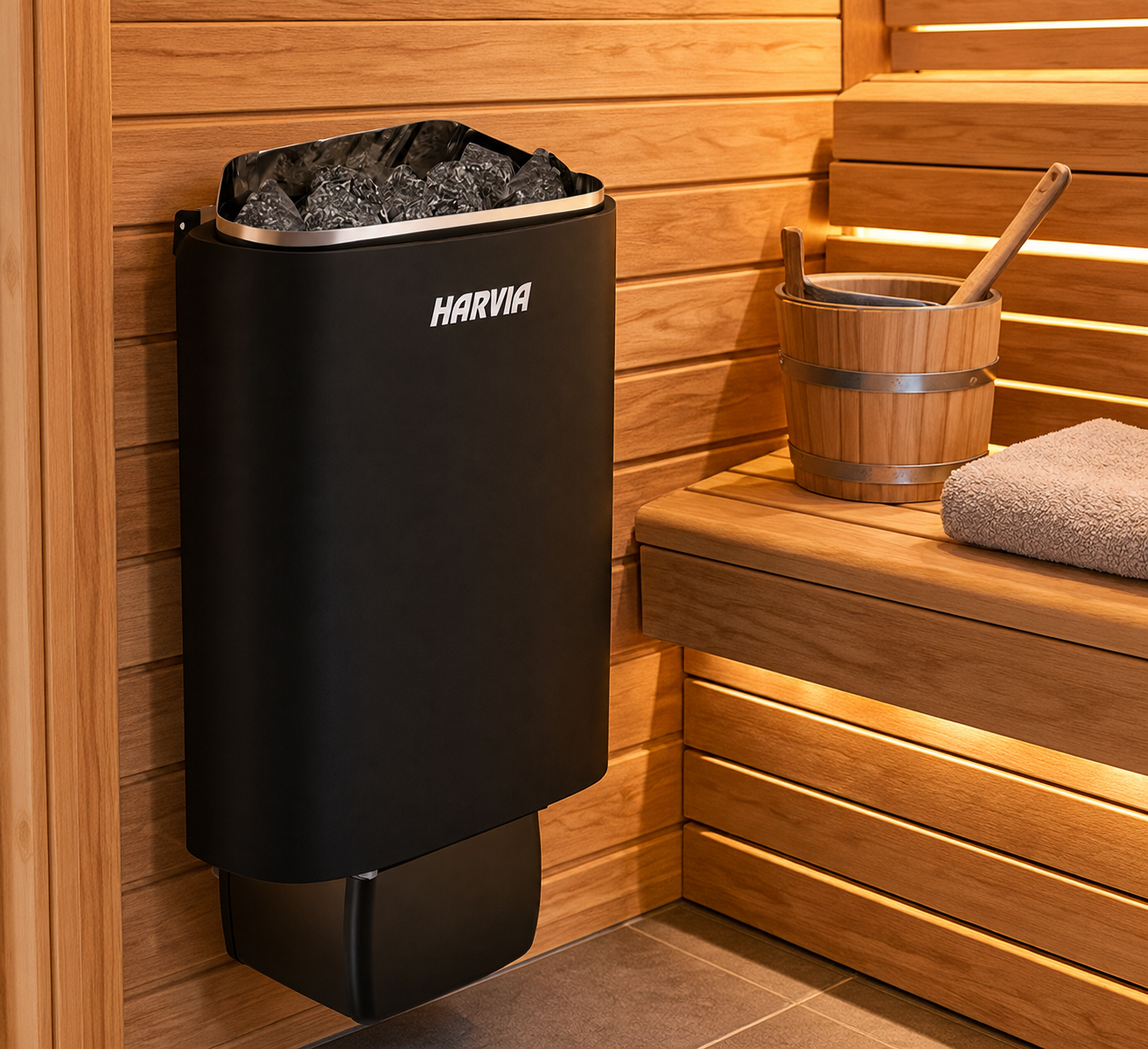
Sauna heater safety begins long before anyone notices a burning smell. It starts when choosing a heater, planning its position and entrusting its installation to a qualified professional. The recall and inspection campaign involving Harvia Delta 3 D36E electric sauna heaters in Japan serves as another reminder of this principle. The case is not a reason for unnecessary alarm, but it clearly demonstrates why even small deviations from the manufacturer’s installation requirements should never be dismissed as insignificant.
Inside a sauna, high temperatures, wooden structures, moisture and powerful electrical equipment exist together. As long as everything operates normally, we rarely think about the potential risks. However, safety depends on more than the quality of the heater itself. Correct installation, distances from combustible materials, wall construction, ventilation and the condition of the electrical system are equally important.
Harvia Delta 3 Recall in Japan: What Happened?
On 20 April 2026, a recall notice was published in Japan concerning Harvia Delta 3 Black and Delta 3 Silver electric sauna heaters with the model designation D36E. The campaign covers 326 units sold in Japan between July 2021 and 31 March 2026.
The manufacturer’s representative reported cases in which discolouration had been observed on the wall above a heater installed in a corner. According to information published by Japan’s Ministry of Economy, Trade and Industry, the risk was associated with corner installations where the specified spacing arrangement had not been used, potentially allowing the wall surface to become excessively hot.
The official notice does not report an actual fire or any injuries. The measures were introduced as a precaution to prevent a possible fire caused by prolonged heating of wooden materials.
Owners are being offered a free installation inspection. If the heater is installed in a corner and the wall behind it is made of combustible material, an appropriate protective plate will be installed. According to the Japanese notice, this additional measure is not required when the rear wall is made of non-combustible material.
It is important to understand that the campaign concerns units sold in a particular country and specific installation conditions.
The Japanese product information for the D36E lists a power output of 2.7 kW and a voltage of 200 V, while versions rated at 3.6 kW are also available under the D36E designation in other markets.
Therefore, the model name alone is not sufficient to determine whether a Harvia Delta heater installed in Europe is affected by the recall. Owners should check the complete product code, rating plate, country of purchase and information provided by the seller.
Why Can a Wooden Wall Overheat Without an Open Flame?
A hot sauna heater warms more than the air and sauna stones. It also transfers heat to nearby walls, sauna benches and other objects through thermal radiation.
If wood is repeatedly or continuously exposed to excessive heat, gradual thermal decomposition may occur. The material can dry out, darken, begin to char and eventually become more susceptible to ignition.
The danger is that heat-related damage to wood can develop gradually without being immediately noticeable.
A single heating session may not produce flames, and everything may appear normal during subsequent sauna visits. However, repeated overheating can gradually change the properties of the wood itself.
Safety should therefore be assessed not only by whether a fire has occurred in the past, but also by examining what happens to surrounding structures over months and years of use.
Yellowing wood, dark patches or marks resembling scorching should not be dismissed as merely cosmetic defects. They may indicate excessive heat exposure in a particular area.
Sauna Heater Safety Begins with Correct Safety Clearances
There is no single universal safety clearance suitable for every sauna heater.
Manufacturers specify installation requirements for each model, taking into account its power, construction, mounting method, permitted positioning and surrounding materials.
Clearances may differ for side and rear walls, floors, ceilings, sauna benches and protective barriers.
Even heaters that look almost identical may have substantially different installation requirements.
For this reason, the primary reference must always be the installation and operating manual for the exact heater model installed in the sauna.
Owners should not rely on a remembered measurement, a diagram found online or an installation example involving another heater.
If the manual has been lost, the first step is to identify the complete model designation and product code on the heater’s rating plate. The appropriate documentation should then be obtained from the manufacturer or an authorised distributor.
An overview of different types of equipment is also available in the Sauna Heaters and Fireplaces section. However, the final installation must always comply with the documentation for the selected model.
Why Is an Ordinary Metal Sheet on the Wall Not a Safety Guarantee?
Sometimes it may seem that the problem can be solved simply by attaching a metal sheet between the heater and a wooden wall.
However, metal conducts heat efficiently, so this type of protection is not always safe.
If the sheet is fixed directly to wood without a specified non-combustible backing or ventilated air gap, it may transfer heat into the structure rather than protect it.
An effective heat shield is a complete technical solution, not merely a piece of material.
Its construction, position, fixings, airflow and compatibility with the heater manufacturer’s instructions are all important.
Even a factory-made protective shield does not automatically permit reduced safety clearances unless the manufacturer has explicitly approved that combination.
A similar lesson can be drawn from the previously discussed Sauna360 recall: a safety component provides protection only when the entire system is installed and operated according to the specified requirements.
Installing an Electric Sauna Heater Is Not a DIY Project
An electric sauna heater requires an appropriate power cable, protective devices, electrical connections and control system.
These requirements depend on the heater’s power output, voltage, connection type and the manufacturer’s technical specifications.
The fact that a heater switches on and begins to warm up does not mean that it has been connected safely.
Electrical installation must be carried out by a qualified professional.
Owners should not attempt to reconnect wiring, replace protective devices, bypass temperature limiters or modify the manufacturer’s intended construction.
If a circuit breaker or overheating protection repeatedly trips, this is not an obstacle to bypass. It is a warning that the underlying cause must be identified.
Sauna conditions are also influenced by the relationship between heater power, room volume and ventilation.
Further information about this balance can be found in the article Temperature and Humidity in the Sauna.
Five Common Mistakes That Increase the Risk of Overheating
1. Installing the heater too close to wooden structures.
Sometimes this is done to gain a few additional centimetres of space. However, such a compromise may expose a wooden wall to prolonged overheating.
2. Using the installation diagram for another model.
Heaters from the same manufacturer, or with a similar appearance, may have entirely different safety clearance requirements.
3. Installing a homemade protective shield.
A metal sheet, tile or other non-combustible surface does not, by itself, prove that the heat exposure of the underlying wooden structure is safe.
4. Failing to recheck clearances after renovations.
New sauna benches, railings, wall cladding or a raised floor can significantly alter the original installation conditions.
5. Treating warning signs as normal wear and tear.
A burning smell, darkening wood, deformed components or repeated activation of protective devices should not be regarded as ordinary signs of an ageing heater.
How Can Owners Check Their Sauna for Safety?
Begin by checking the heater’s rating plate and installation manual.
Make sure that the complete model designation, power output and installation method match the documentation.
Then compare the actual clearances with the manufacturer’s installation diagrams.
Carefully inspect all nearby wooden surfaces, particularly those behind and above the heater and in the corners of the room.
Pay particular attention to the following warning signs:
-
Changes in wood colour, dark patches or signs of charring.
-
New cracks or unusually heavy resin release.
-
A persistent burning smell or the smell of overheated electrical wiring.
-
Loose mounting points or deformed protective components.
-
Towels, wooden containers or other objects stored too close to the heater.
This should be a visual inspection only.
Owners should not dismantle the heater or open electrical distribution equipment without the appropriate qualifications.
If there is any uncertainty, a qualified specialist should be consulted.
When Must the Sauna Heater Be Taken Out of Use Immediately?
The heater must no longer be used if wood is visibly darkening or charring, a burning smell is present, crackling can be heard from electrical connections, wiring appears damaged or components are deformed.
Repeated activation of protective devices is another warning sign.
Operation should also be suspended if it is not possible to confirm that the installation complies with the manufacturer’s instructions.
If smoke or signs of fire appear, everyone should leave the area immediately and contact emergency services. In Latvia and throughout the European Union, the emergency number is 112.
Water must not be used to extinguish fires involving electrical equipment that remains energised.
A sauna heater specialist or competent building professional should assess the installation, wall construction and heat protection.
The electrical system should be inspected by a qualified electrician.
An Old Heater Is Not Safe Simply Because Nothing Has Gone Wrong Before
The statement “it has been installed here for ten years” is not technical evidence of safety.
Over time, electrical connections may loosen, mounting points may become unstable, protective components may deform and the condition of surrounding walls may change.
The sauna interior may also have been renovated without reassessing the original safety requirements.
Prolonged exposure to heat is one of the reasons why an older installation deserves the same careful inspection as a new one.
The fact that nothing happened during previous heating sessions does not mean that the surrounding structure has not been gradually damaged.
What Can Sauna Owners in Latvia Learn from the Harvia Delta 3 Case?
Sauna heater safety is not determined by a single component or one correctly measured distance.
It is a complete system in which the heater model, room construction, protective materials, ventilation and electrical installation must all work together.
The Japanese case also demonstrates the importance of responding responsibly to early warning signs.
Wall discolouration was not treated merely as a visual defect. An inspection campaign was launched to prevent a possible future fire.
Sauna owners in Latvia should not wait until smoke or flames appear either.
If there are doubts about the heater model, safety clearances, wall protection or electrical connections, the safest approach is to stop using the equipment and consult a specialist.
Sauna heater safety begins with attention to detail. Timely inspections, compliance with the manufacturer’s requirements and proper assessment of warning signs can help prevent dangerous situations before they develop into fires. The true value of a good sauna lies not only in its pleasant warmth, but also in the confidence that this warmth does not endanger the people using it or the building itself.
