
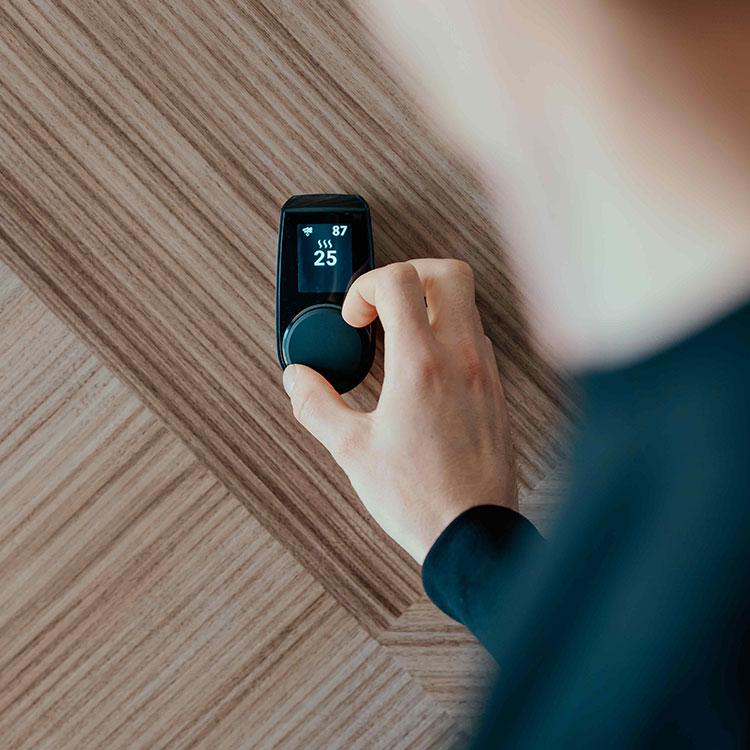
Smart Sauna 2026 no longer means simply an electric heater that can be switched on with a smartphone. Modern digital systems can monitor temperature and humidity, analyse sauna use, predict heating time and track energy consumption. Technology is now entering even the traditional wood-burning sauna, showing how rapidly an environment that existed for centuries without sensors, apps or cloud services is changing.
Finnish sauna technology manufacturer Harvia is one of the companies actively developing this field. The MyHarvia Smart Sauna Sensor is installed inside the sauna, where it collects information about temperature, humidity and sauna use. The data is transferred to a digital system, allowing users to monitor sauna performance and analyse how it behaves over time.
Unlike a conventional thermometer, the sensor does more than display the current temperature. The idea is to use accumulated data to understand how quickly a particular sauna heats up, how long it is used and how its performance changes over time.
Smart Sauna 2026 learns how each sauna behaves
One of the most interesting possibilities offered by digital systems is heating-time prediction. Once the system knows how a particular sauna has behaved during previous sessions, it can calculate how much longer it will take to reach the selected temperature.
This means users no longer need to check the thermometer every ten minutes. Information about sauna readiness can be delivered to a smartphone, while the system can also indicate when heating is progressing differently from usual.
The reason for such a difference may be very simple – an open door, for example. Over time, however, collected data can also help identify changes in the performance of the heater or the sauna itself.
Even a wood-burning sauna can become smarter
One of the most interesting technological developments is that digital sensors are no longer intended exclusively for electrically heated saunas. They can also be used in a traditional wood-burning sauna.
A sensor obviously cannot add another log to the fire. It can, however, monitor changes in temperature and help determine when the heat is beginning to fall and additional firewood may be needed.
This significantly broadens the meaning of a smart sauna. Previously, the term was primarily associated with remotely switching on an electric heater and controlling its temperature. Digital systems are now beginning to analyse traditional wood-burning saunas without changing their fundamental principles – fire, wood and heated stones.
The sauna begins to build its own data history
A digital system can register each sauna visit as a separate session. Over time, information accumulates about frequency of use, heating duration, temperatures reached and other parameters.
For a private household, such statistics may simply be interesting. In a professional environment, however, they can have much greater practical value. A hotel, spa or public sauna may operate several sauna rooms at the same time, and staff do not need to physically visit every room continuously to check temperature and readiness.
A centralised system can show the status of several saunas, their usage history and long-term trends in one place. Sauna management therefore begins to resemble other modern building-automation systems.
Can data reduce energy consumption?
One of the main arguments for smart sauna technology is energy efficiency. Traditionally, an electric sauna may be switched on with a generous time allowance – better too early than too late. As a result, a fully heated sauna can remain empty for a considerable period before anyone enters.
If the system knows how long a particular room usually takes to reach the required temperature, heating can begin at a more precise time. This can reduce the period during which an empty sauna is unnecessarily maintained at operating temperature.
The potential becomes even more significant in professional settings. In a hotel or spa with several saunas, even a relatively small reduction in unnecessary heating time for each heater can result in meaningful energy savings over the course of a year.
Data can also help with sauna maintenance
Long-term measurements can be useful for more than analysing energy consumption. If a sauna suddenly begins heating more slowly under otherwise similar conditions, it may indicate that something in the system has changed.
One possible cause is the condition of the sauna stones. Repeated heating and cooling causes stones to crack, deteriorate and become more tightly packed, potentially restricting airflow through the heater and reducing heating efficiency.
A sensor will not replace the stones, but historical data can help identify when the sauna is no longer performing as it once did. Digital monitoring can therefore begin to play a role in preventive maintenance as well.
The smartphone becomes a sauna control panel
With compatible electric heaters, smart sauna technology offers another capability – remote control. Users can monitor temperature, see the estimated readiness time and select previously saved sauna settings from a smartphone.
In professional environments, such systems can also be integrated with broader building-management platforms. The sauna is therefore no longer an isolated room containing its own heater and thermometer, but one digitally manageable element within a larger building.
This is where sauna technology begins to overlap with smart-home systems and modern building automation.
Remote control also creates safety questions
The ability to switch on an electric sauna while nobody is at home is convenient, but it raises an obvious question: what happens if a towel or another object has been left on the heater?
Remote control therefore cannot simply be a smartphone button connected directly to a sauna heater. Additional safety mechanisms are required, including door sensors and other protective devices, while installation and operation must comply with the requirements of the particular system and applicable safety standards.
A sauna heater operates at very high temperatures, which means automation requires much more serious safety measures than remotely switching on household lighting.
How much technology does a sauna actually need?
This is where the discussion becomes particularly interesting. Temperature monitoring, more precise heating, lower energy consumption and early detection of technical problems offer clear practical advantages. Historically, however, sauna has also been one of the places people visit specifically to get away from phones, notifications and the constant flow of information.
The development of the smart sauna therefore creates an interesting contradiction. Technology should help prepare, monitor and improve the efficiency of the sauna, but it does not necessarily need to follow the user onto the sauna bench.
Finding this balance may become one of the most important questions for future sauna technology – how much automation genuinely improves the experience, and at what point does it begin to interfere with it?
From smoke sauna to cloud services
The contrast between traditional and modern sauna is particularly striking today. In a Võromaa smoke sauna, an experienced person can judge from the heater, stones, smell and physical sensations when the sauna is ready. In a smart sauna, some of that work is performed by a sensor, an algorithm and a mobile application.
These approaches do not necessarily contradict one another. A digital sensor does not eliminate firewood, stones or sauna tradition. It simply adds another layer of information that can be used when needed.
This combination may become one of the most interesting directions for the future – the traditional sauna retains its essential character while technology works quietly in the background to make it safer and more efficient.
Smart Sauna 2026 aims to become almost invisible
Perhaps the best sauna technology of the future will not be the technology users constantly see and interact with. Instead, it may operate quietly in the background, helping the sauna heat up at the right time, reducing unnecessary energy consumption, detecting unusual changes and reminding users when maintenance is needed.
Once a person enters the sauna, the screen no longer needs to be the centre of attention.
Smart Sauna 2026 shows that digital technology is beginning to enter even the traditional wood-burning sauna. A sensor can measure, analyse and warn, but an algorithm does not replace the sauna experience itself. Perhaps the smartest technology will be the technology that completes its work before a person sits down on the sauna bench – and then allows the phone to remain outside the door.
Sources
Harvia – MyHarvia Smart Sauna Sensor WiFi.
Harvia – Harvia Smart Sauna.
Harvia – MyHarvia 2.
Harvia – Smart Sauna Solutions for Hotels, Spas and Rental Properties.
Harvia Plc – Annual Report 2025.


