
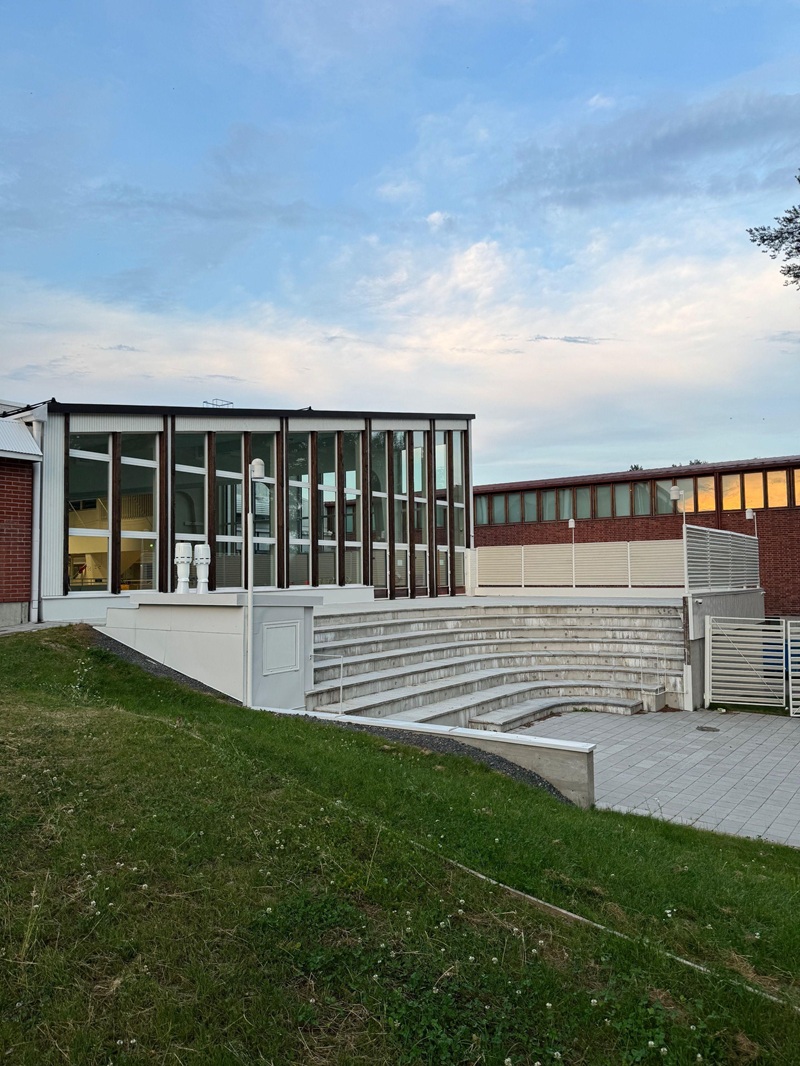
Alvar Aalto’s wood-heated sauna in Jyväskylä has been regularly heated again since 1 September and is open for public sauna evenings. The historic sauna is located at the AaltoAlvari Aquatics Centre, whose original building was designed by one of Finland’s most internationally renowned architects, Alvar Aalto. Two large Aitokiuas wood-burning heaters, a traditional Finnish sauna experience and a location within a UNESCO World Heritage setting make this much more than an ordinary public sauna.
In Finland, public sauna culture and significant architecture are not two separate worlds. In Jyväskylä they meet at the AaltoAlvari Aquatics Centre, where the season of the historic wood-heated sauna has resumed after a break.
From 1 September until 15 December, the sauna is heated regularly twice a week. Public mixed sauna evenings take place on Tuesdays and Fridays from 15:00 to 20:30 and are open to visitors of the aquatics centre.
Alvar Aalto’s Wood-Heated Sauna is part of historic AaltoAlvari
The history of AaltoAlvari dates back to 1955, when the swimming complex designed by Alvar Aalto opened. The City of Jyväskylä describes it as the world’s only swimming pool designed by Alvar Aalto.
The aquatics centre has been expanded several times over the decades and today is one of Finland’s largest in terms of total pool water surface area. However, the original wood-heated sauna has survived in the oldest part of the complex.
This connection between a functioning modern sports centre and historic architecture is what makes AaltoAlvari particularly interesting. People do not come here simply to look at a preserved architectural monument – the building continues to fulfil its original public function.
Two large Aitokiuas heaters
At the heart of the sauna are two large Aitokiuas wood-burning heaters. This type of Finnish sauna heater is well known for its large mass of stones and its ability to store a considerable amount of heat.
Unlike an ordinary continuously heated wood-burning sauna stove, Aitokiuas belongs to the heat-storage type. The large mass of stones is thoroughly heated before the sauna session, after which the stored heat is used for bathing.
Preparing such a heater requires time and experience. This is one reason why the City of Jyväskylä recommends checking on the morning of a planned visit whether that day’s public sauna evening will take place.
Weather can affect the heating of the sauna
A wood-heated sauna is not an electric sauna where someone simply presses a button and selects a temperature. At AaltoAlvari, weather conditions can also affect whether the sauna can be heated.
The city therefore advises visitors to check the electronic booking system on the morning of a public sauna day. If the sauna is being heated and the evening will go ahead, this is indicated in the system.
This seemingly small detail illustrates the difference between a traditional wood-heated sauna and a fully automated modern sauna. Even in a public sports complex, fire and weather still determine part of the sauna’s rhythm.
A public sauna evening costs €2.50
The historic sauna has not been transformed into an expensive exclusive spa experience.
Admission to a public sauna evening costs €2.50 in addition to the normal AaltoAlvari entrance fee. Visitors receive a separate wristband at reception, which is scanned at the sauna entrance.
During public evenings, the sauna is shared by women and men, so visitors use the sauna wearing swimwear.
This model keeps the historic sauna accessible as a genuine public service rather than turning it solely into an architectural attraction for tourists.
Visitors can bring their own sauna whisk
Being allowed to use your own sauna whisk is not necessarily standard practice at a Finnish public swimming facility, but it is permitted in the AaltoAlvari wood-heated sauna.
Visitors may bring their own whisk, but after using the sauna they must wash thoroughly before entering the swimming pools to prevent leaves or other plant material from getting into the water.
AaltoAlvari itself does not sell sauna whisks, so anyone wishing to use one must bring their own.
This small detail preserves a practical connection between the historic architecture and traditional sauna culture.
The sauna can also be booked privately
The historic wood-heated sauna is not available only during public evenings. It can also be reserved for a private three-hour event.
A private reservation costs €300 on weekdays and €450 at weekends, in addition to the normal AaltoAlvari entrance fee.
The sauna therefore continues to function as a social space where people can gather for an evening, celebration or another private occasion.
This fits well with the traditional Finnish understanding of sauna as more than simply a place to wash – historically, it has also been a place for people to spend time together.
Alvar Aalto’s architecture has become UNESCO World Heritage
In 2026, the surroundings of AaltoAlvari gained even greater international significance. Aalto Works – a group of 13 buildings and architectural ensembles in Finland designed by Alvar Aalto and his collaborators – was inscribed on the UNESCO World Heritage List.
One of these sites is the Aalto Campus in Jyväskylä. AaltoAlvari and its historic wood-heated sauna are located in the Seminaarinmäki campus environment of the University of Jyväskylä, associated with this UNESCO heritage setting.
UNESCO particularly highlights Aalto’s ability to combine the ideas of international modernism with local building traditions and architecture designed around human wellbeing.
The swimming pool and sauna provide an especially clear way to understand this idea – the architecture was not created merely to be looked at, but to be used in everyday life.
Modernism and a traditional wood-heated sauna under one roof
Alvar Aalto is regarded as one of the most important modernist architects of the 20th century, but his architecture was never simply about concrete, glass and modern forms.
Human experience, natural materials, light and the relationship between buildings and their surroundings played an important role in his work.
The AaltoAlvari wood-heated sauna is particularly interesting in this respect. Inside a modernist architectural complex, one of Northern Europe’s oldest wellbeing technologies is still operating – wood fire, heated stones, water and steam.
While many historic buildings become primarily places to look at after gaining heritage status, here visitors can still simply go to sauna.
Sauna culture as living architectural heritage
AaltoAlvari demonstrates an interesting approach to preserving architectural heritage. The building has not been separated from its original purpose and transformed entirely into a museum.
People still swim in the pools, wood is still burned in the sauna heaters, water is still thrown onto hot stones and visitors still sit on the sauna benches.
Continuing to use the building in this way preserves more than walls and architectural details. It also preserves the experience for which the building was originally created.
This is particularly important in sauna culture because a sauna cannot truly be preserved simply as an empty room. A sauna exists when the heater is fired, the stones become hot and people enter the space.
Alvar Aalto’s Wood-Heated Sauna is alive again
Public sauna evenings at AaltoAlvari will continue twice a week until 15 December. This offers visitors an opportunity to experience both a traditional Finnish wood-heated sauna and architecture connected with world cultural heritage in a single evening.
No exclusive reservation or expensive spa package is required. Visitors need only the regular aquatics centre admission ticket and an additional €2.50 for the wood-heated sauna.
Alvar Aalto’s Wood-Heated Sauna in Jyväskylä is a good example of how cultural heritage can be not only preserved but kept alive. The two Aitokiuas heaters are still fired, people still arrive with their own sauna whisks, and modernist architecture continues to serve the purpose for which it was created. Sometimes the best way to preserve a historic sauna is remarkably simple – keep heating it.
Sources
City of Jyväskylä – The wood-heated sauna at the AaltoAlvari Aquatics Centre will reopen on 1 September.
City of Jyväskylä – information about the AaltoAlvari Aquatics Centre.
UNESCO World Heritage Centre – Aalto Works.
UNESCO World Heritage Committee – inscription of Aalto Works on the World Heritage List in 2026.


