
International Sauna Congress 2026 will take place in Oslo from 24 to 26 September, bringing together more than 40 speakers and sauna industry representatives from over 25 countries. Over three days, researchers, architects, sauna professionals, industry organisations, manufacturers and public sauna operators will discuss not only traditions, but also health research, technology, urban saunas, sustainability and the future of sauna culture. This year’s programme demonstrates just how far the modern sauna world has expanded beyond the basic questions of heat and heaters.
The International Sauna Congress is held once every four years, each time in a different country. The first congress took place in Bielefeld, Germany, in 1956, while this year the global sauna community will gather in the Norwegian capital.
The congress is organised by Norges Badstulaug, the Norwegian Sauna Association, together with the International Sauna Association. Their aim is to bring together sauna culture, science, medicine, architecture, technology and the people who are actively developing the sauna sector in different parts of the world.
International Sauna Congress 2026 opens at Oslo City Hall
The congress will open on 24 September at Oslo City Hall – the same building where the Nobel Peace Prize ceremony is held each year. The opening programme will introduce participants to Norwegian badstue culture, followed by an official reception.
In the evening, congress participants will visit The Well, one of the largest spa complexes in the Nordic region. Sauna professionals will have an opportunity not only to continue discussions but also to experience different saunas, pools and other heat-and-water environments themselves.
On 25 and 26 September, the main congress programme will continue at Rebel Oslo, with several thematic stages operating simultaneously.
Sauna and health – from the laboratory to real life
One of the congress’s central themes will be Sauna & Health. In recent years, a growing body of research has examined associations between regular sauna use and cardiovascular health, blood pressure, stress and other health indicators. The congress, however, will look not only at potential benefits but also at the limitations of existing research.
One discussion will address a particularly important question: do laboratory sauna studies really reflect the way people use saunas in everyday life? A controlled experiment with a fixed temperature and duration is not necessarily comparable with a real sauna session in which heat, humidity, rest periods and individual behaviour vary.
The combination of heat and cold will also receive attention. Cold-water immersion has become extremely popular in recent years, but researchers are still examining how much of the observed effect is associated with heat, how much with cold, and how much with the combination of the two.
Could sauna become a public health tool?
One of the most interesting discussions will explore whether sauna could eventually become part of public health policy.
Interest in so-called social prescribing is increasing in several countries. Alongside conventional medical treatment, people may be encouraged to take part in physical activity, social programmes or other activities that can support wellbeing.
Congress participants will discuss whether sauna could play a similar role. The conversation will not focus solely on potential benefits. The quality of scientific evidence, cost and accessibility will also be important questions, particularly if public saunas are to serve a broad section of society rather than only those who can afford premium wellness services.
How saunas are transforming urban waterfronts
Public waterfront saunas will receive particular attention in the architecture and urban development programme.
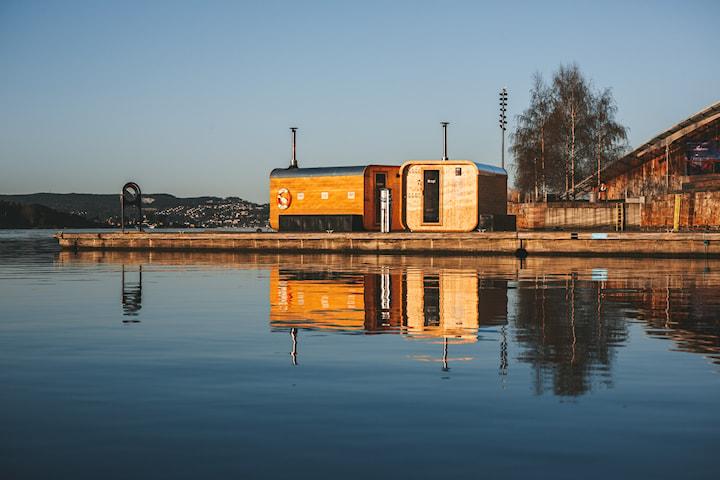
Oslo is an especially appropriate location for this discussion. Floating saunas in the city’s harbour have become one of the most visible symbols of Norway’s new urban sauna culture. Areas where access to the water was once limited are now places where residents can use a sauna and then enter the fjord.
The session “Swimmable Cities: How Saunas Can Remake Urban Waterfronts” will examine how sauna can help cities reconnect people with their waterfronts. The issue is increasingly relevant as public saunas are planned not simply as isolated spa facilities but as part of wider urban infrastructure.
Which stones are really best for sauna?
The congress programme will also address a question that experienced sauna enthusiasts can debate for a very long time: which stones are actually best for a sauna heater?
Specialists will compare peridotite, olivine diabase, volcanic rock, gabbro and other stone types. The discussion will go beyond heat-storage capacity to consider how stones behave during repeated heating and cooling cycles, how they crack, whether they produce dust and how they affect the quality of steam.
Sustainability is also becoming increasingly important. Where are sauna stones sourced? How long do they last? How frequently should they be replaced? A seemingly simple component of a sauna therefore involves geology, physics, energy efficiency and everyday use.
Wood-burning sauna heaters face increasing scrutiny
Another technology discussion will focus on wood-burning sauna heaters. For many sauna enthusiasts, fire, the sound of burning wood and the wood-fired heater itself are essential parts of the sauna experience. At the same time, cities are paying increasing attention to particulate matter and smoke emissions.
The congress will examine a new generation of sauna heaters designed to achieve cleaner and more efficient combustion. The practical question is whether wood-burning saunas can retain their place in cities and regulated waterfront environments if air-quality requirements continue to become stricter.
In the future, choosing a sauna heater may therefore involve more than power output and the amount of stone it can hold. Combustion efficiency and emissions could become equally important considerations.
Does technology improve or spoil the sauna?
Apps, remotely controlled heaters, sensors, automation, lighting systems and sound are increasingly entering modern saunas. For some people, these technologies provide greater convenience and more precise control. For others, they represent an unnecessary intrusion into a space that should remain simple and analogue.
International Sauna Congress 2026 will dedicate a discussion to precisely this question: does technology improve or spoil the sauna experience?
This is not merely a philosophical debate. The sauna industry is developing rapidly, and manufacturers are offering increasingly sophisticated automated solutions. The sector therefore needs to find the boundary between technology that genuinely improves the sauna experience and technology that adds complexity without meaningful value.
The global sauna boom is creating new questions
The term sauna boom appears repeatedly throughout the congress programme, reflecting the rapid growth in sauna’s popularity around the world. Public saunas are opening in cities, on waterfronts, at hotels and in natural settings, while sauna culture is expanding quickly even in countries without a deep historical sauna tradition.
This growth creates business opportunities, but it also raises questions about quality and even the meaning of the word “sauna”. One panel poses a deliberately provocative question: if everything begins to be called a sauna, does the word “sauna” eventually lose its meaning?
Participants will discuss the boundaries between Finnish sauna, different global sweating and bathing traditions, infrared cabins and contemporary commercial heat concepts.
Oslo will demonstrate its sauna culture in practice
International Sauna Congress 2026 will not be confined to conference rooms. Friday evening will feature a Floating Sauna Night, allowing participants to experience Oslo’s floating sauna environment and combine sauna heat with swimming in the fjord.
The final evening will feature Badstufest with music, food, sauna sessions and different sauna rituals. In this way, the congress will combine academic and professional discussion with direct sauna experience.
That is important to the idea of the congress itself – discussing sauna without separating the conversation from real sauna culture.
Oslo will become a centre of the global sauna world for three days
The International Sauna Congress is held only once every four years, making the 24–26 September gathering one of the most significant sauna industry events of 2026. More than 40 speakers will participate, over 15 panel discussions are planned, and representatives from more than 25 countries are expected.
The breadth of the programme demonstrates how much the conversation around sauna has changed. Tradition now sits alongside medicine, urban planning, architecture, air quality, technology, social inclusion and sustainability.
International Sauna Congress 2026 will show how the sauna world is trying to preserve its historical roots while sauna culture experiences one of the most significant waves of international popularity in its modern history. For three days, Oslo will become a place where the discussion is not only about what sauna is today, but also about what it could become in the future.
Sources
International Sauna Congress 2026 – official congress programme.
International Sauna Congress 2026 – panel discussion programme.
International Sauna Congress 2026 – information about venues and organisers.
International Sauna Association – information about the International Sauna Congress.


